Examining Cimande as a Healing Tradition and Spiritual Network: Asep Awaludin Earns Doctorate in Nusantara Islam

Humas Unusia
Content Writer
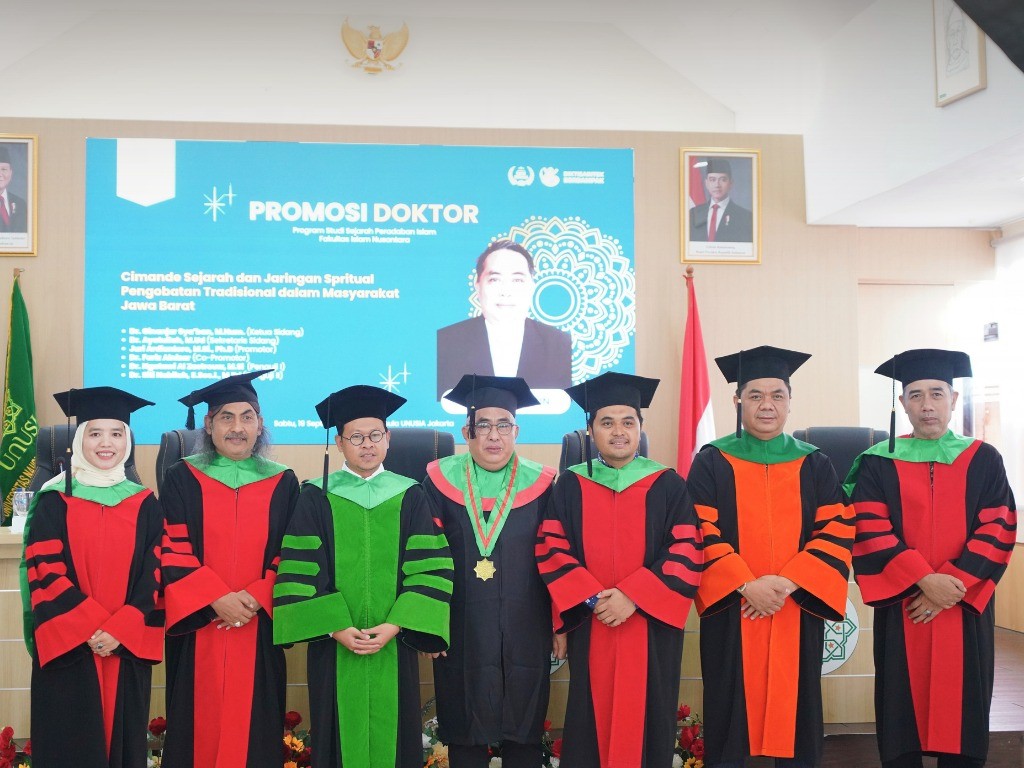
Jakarta — Asep Awaludin, a doctoral student in the History of Islamic Civilization program at the Faculty of Nusantara Islam, Nahdlatul Ulama University of Indonesia (Unusia), passed with an 'A' grade during his open dissertation defense held at Unusia Jakarta on Saturday (September 19, 2026). During the defense, Asep presented his dissertation titled "CIMANDE: A History of Traditional Healing and Spiritual Networks in West Javanese Society."
This research examines Cimande as a "living tradition"—a tradition that remains active and vibrant within the community. Asep views Cimande not merely as a technique for traditional healing or *pencak silat* (martial arts), but as a cultural and knowledge system that integrates healing practices, Islamic rituals, teacher-student relationships, and social networks.
Conducted in Cimande Village, Caringin District, Bogor Regency, the study employs a qualitative approach, combining historical and ethnographic methods. The scope of the study covers the evolution of the Cimande tradition from the 20th to the 21st century, including the processes of knowledge transmission and the healing practices that have developed within it.
Regarding healing practices, the research discusses the anamnesis process—involving communication about ailments and manual examinations—as well as the identification of conditions such as fractures, cracks, joint dislocations, and sprains, leading up to the actual treatment. These practices operate alongside the spiritual dimensions that are integral to the Cimande tradition.
Spiritual aspects are evident in practices such as prayer, *shalawat* (invocations of blessings upon the Prophet), *wirid* (recitations), *tawasul* (seeking intercession), *jangjawokan* (traditional incantations), fasting, *tirakat* (ascetic spiritual discipline), and *tafakur* (contemplation). These elements are not only linked to religious observance but also play a role in character building and establishing the healer's legitimacy. Legitimacy is further established through the *sanad* system—a teacher-student lineage passed down through discipline, *ijazah* (formal authorization/certification), and a connection to the tradition's history.
Asep’s research also examines the Cimande tradition's capacity to adapt to changes in the modern era. In the 21st century, values such as spirituality, ethics, and *sanad* (chains of transmission) remain integral to the tradition, while communication technology and social media serve as tools to reach a wider audience.
The open examination was chaired by Dr. Ginanjar Sya'ban, M.Hum., with Dr. Ayatullah, M.Ud. serving as the session secretary. Juri Ardiantoro, M.Si., Ph.D. acted as the Promoter, and Dr. Fariz Alnizar, M.Hum. as the Co-Promoter. Meanwhile, Dr. Ngatawi Al Zastrouw, M.Si. and Dr. Siti Nabilah, S.Sos.I., M.Pd. served as the first and second examiners, respectively.
This open examination is part of the academic process of the Doctoral Program in the History of Islamic Civilization at the Faculty of Nusantara Islam, aimed at advancing the study of the history, culture, and traditions of Nusantara Islam. Through the study of Cimande, Unusia continues to foster research that explores the interplay between local knowledge, community life, and the dynamics of tradition amidst the changing times.