Minister of Religious Affairs Launches Book by Unusia FEB Dean, Highlighting the Tangible Impact of Religious Diplomacy

Humas Unusia
Content Writer
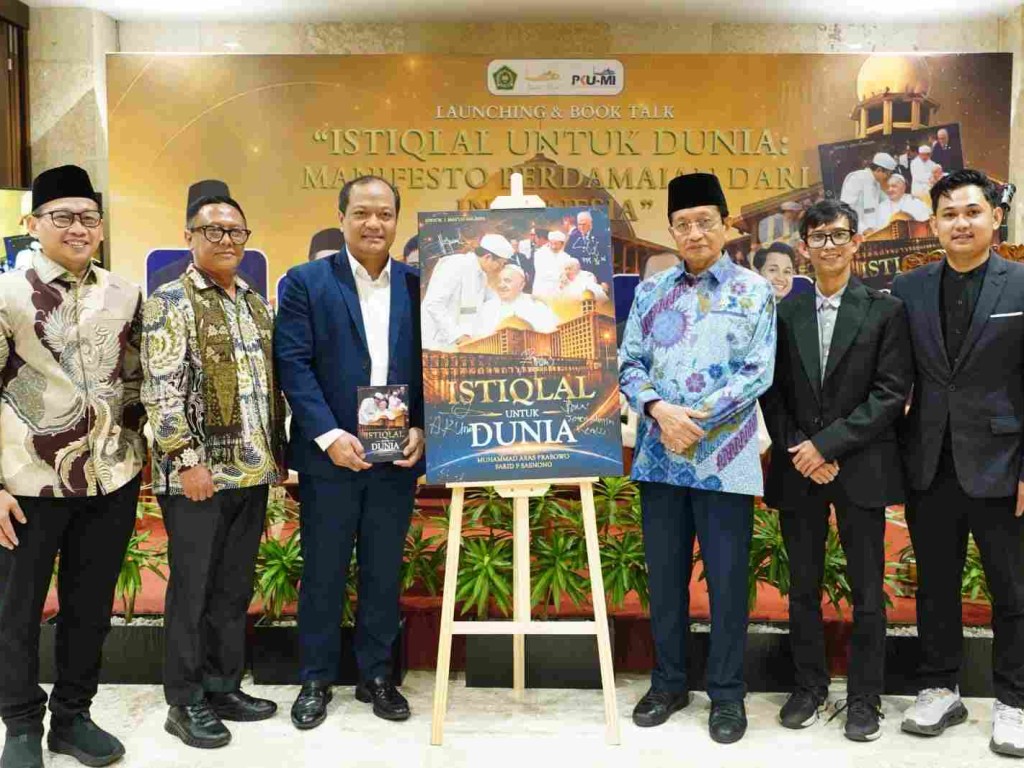
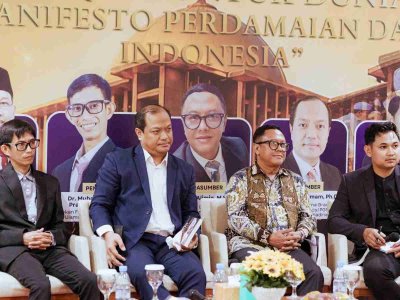
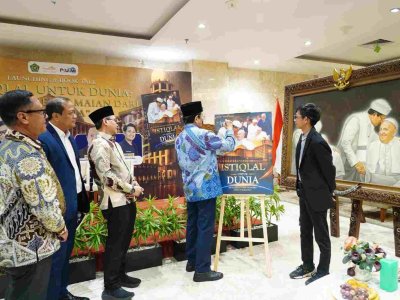
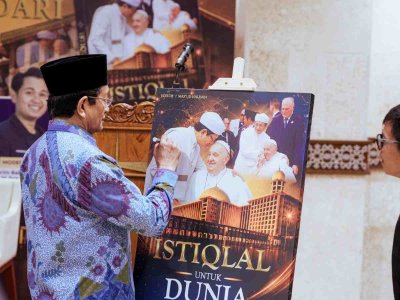
Jakarta – The Minister of Religious Affairs of the Republic of Indonesia, who also serves as the Grand Imam of the Istiqlal Mosque, Prof. Dr. KH. Nasaruddin Umar, has launched a book titled Istiqlal for the World: A Peace Manifesto from Indonesia. The book was co-authored by Dr. Muhammad Aras Prabowo, Dean of the Faculty of Economics and Business (FEB) at the Nahdlatul Ulama University of Indonesia (Unusia), and Farid F. Saenong, Ph.D. The launch serves as a momentum to strengthen the role of religion in fostering peace, community empowerment, and humanitarian diplomacy on a global scale.
The event, titled "Launching & Book Talk" took place in the VIP Room of the Istiqlal Mosque, Jakarta, on Thursday (November 5). It was attended by representatives from the Indonesian Ministry of Foreign Affairs, academics, and various figures involved in the development of Indonesia’s religious diplomacy—including Joneri Alimin, M.Si., Acting Director of Public Diplomacy at the Ministry of Foreign Affairs.
The book expands upon the concepts presented in the Istiqlal Declaration, which was signed by Nasaruddin Umar and Pope Francis on September 5, 2024. Across 16 chapters, the authors explore a range of issues—from peace, interfaith dialogue, and eco-theology to economic justice and Indonesia’s moral diplomacy. These ideas position religion not merely as a foundation for spiritual life, but as a powerful force for addressing humanitarian challenges.
In his keynote address, Nasaruddin Umar emphasized that houses of worship must take on a broader role in society. He argued that a mosque should not be limited to a place for religious rituals; rather, it should serve as a space for resolving social issues and empowering the community.
"Moving forward, a mosque should not just be a place for prostration, but also a hub for addressing the challenges faced by the community and humanity at large," he stated. He also cited the development of the Istiqlal Global Fund as an instrument for economic empowerment and for strengthening the self-reliance of the Muslim community through the management of productive resources.
Meanwhile, Dr. Muhammad Aras Prabowo highlighted the importance of translating religious values into economic and social initiatives that provide direct benefits to society. Through this book, he and his co-author, Farid, aim to demonstrate that religious values can serve as a foundation for building solidarity while fostering more inclusive prosperity.
"Through this book, we want to show that religion can act as a moral energy that unites humanity," Aras stated.
He further advocated for the strengthening of community cooperatives, financial literacy, the empowerment of micro, small, and medium-sized enterprises (MSMEs), and the implementation of social impact audits. According to him, these measures are essential to ensure that mosques function not merely as centers for religious activity, but also as hubs capable of generating measurable economic and social benefits.
The ideas presented were also examined from the perspective of international diplomacy. Joneri Alimin, M.Si., emphasized that Indonesia’s religious diplomacy must move beyond symbolic recognition toward partnerships that deliver concrete benefits to the public. A similar view was expressed by Ahmad Khoirul Umam, Ph.D., Director of the Paramadina Graduate School of Diplomacy, who noted that Indonesia’s moral influence on the international stage requires policy consistency, robust institutional frameworks, and tangible success.
The discussion, moderated by Karim Bakri from the Istiqlal Mosque’s Pendidikan Kader Ulama (Ulama Cadre Education) program (PKUMI), also covered peace education, the strengthening of community economies, and the development of "green" houses of worship. The book’s launch serves as a continuation of the Jakarta Understanding—an outcome of the 2026 International Grand Imams Conference—which reinforces Indonesia’s agenda for humanitarian diplomacy.
Through this work, the authors hope to foster broader collaboration among mosques, universities, the government, and the international community. Through this work, Muhammad Aras Prabowo provides an academic contribution from Unusia toward the development of thought on peace, religious diplomacy, and the economic empowerment of the community.
Unusia consistently encourages its academic community to contribute by advancing knowledge and generating ideas that are relevant to societal needs, while simultaneously strengthening the role of the university in fostering the greater good—both at the national and international levels.