Amsar A. Dulmanan Earns Doctorate by Examining the Genealogy of Gus Dur’s Thought within the Construction of *Islam Nusantara*

Humas Unusia
Content Writer
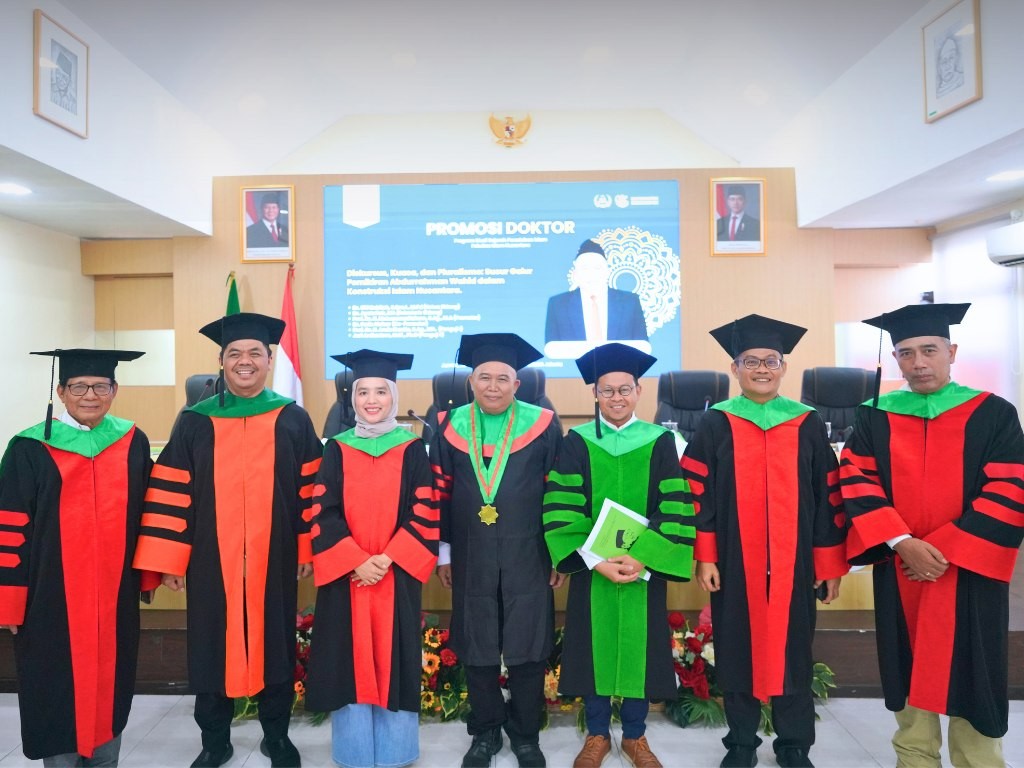
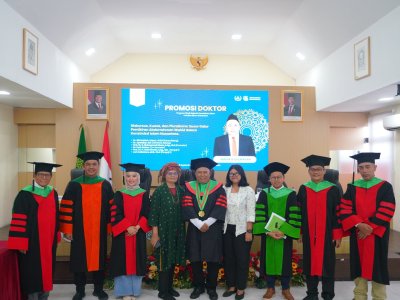
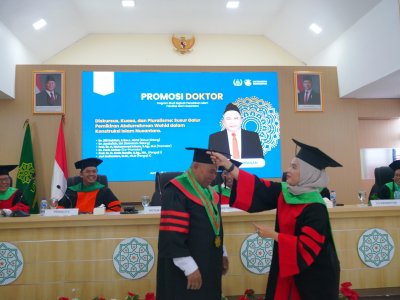
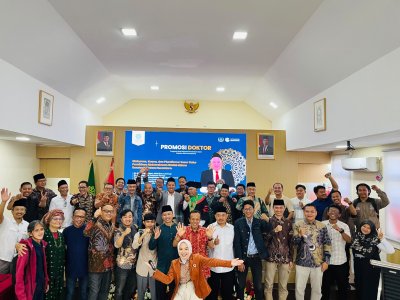
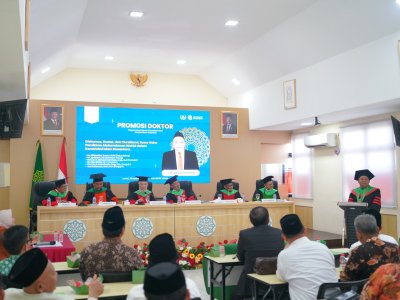
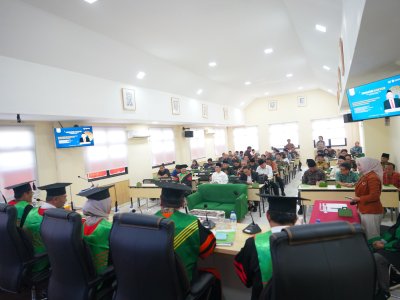
Jakarta — Amsar A. Dulmanan, a doctoral student in the History of Islamic Civilization (SPI) program at the Faculty of *Islam Nusantara*, Nahdlatul Ulama University of Indonesia (Unusia), successfully defended his dissertation during the open doctoral promotion examination on Friday (September 25). Held at the Unusia Jakoeb Oetama Hall, Amsar presented research titled "Power, Discourse, and Pluralism: Tracing the Genealogy of Abdurrahman Wahid’s Thought in the Construction of *Islam Nusantara*." He achieved a grade of A on the examination.
The dissertation examines the formation of Abdurrahman Wahid’s—or Gus Dur’s—thought in relation to the construction of *Islam Nusantara*, utilizing Michel Foucault’s genealogical approach. The study proceeds from the premise that *Islam Nusantara* is a significant discourse within the broader Islamic conversation in Indonesia, while recognizing that its historical construction remains open to critical re-examination. Gus Dur’s thought was selected as the subject due to his intellectual journey, which spanned the *pesantren* (Islamic boarding school) environment, the worlds of intellect and culture, leadership within the Nahdlatul Ulama (NU), and his tenure as a statesman.
"*Islam Nusantara* represents the discursive accumulation of five phases in the evolution of Gus Dur’s thought, with power-knowledge relations and pluralism serving as its primary pillars."
Employing a qualitative-historical approach grounded in Foucauldian genealogy, Amsar maps the evolution of Gus Dur’s thought into five distinct phases. These phases comprise the *santri* phase (1940–1963), the intellectual phase (1963–1971), the cultural figure phase (1971–1984), the *kiai* and NU leader phase (1984–1999), and the statesman phase (1999–2009). These five phases illustrate the evolution of Gus Dur’s thought, shaped by the interplay of *pesantren* (Islamic boarding school) traditions, Islamic thought, culture, organizational dynamics, and his experiences in statecraft.
The study also identifies *Islam Nusantara* as a discursive formation possessing historical, relational, dynamic, contextual, and emancipatory dimensions. Within this construct, *Islam Nusantara* does not exist in isolation from other discourses but constantly interacts with Arabism, secularism, nationalism, and globalism. Power-knowledge relations play a crucial role in the formation and evolution of this discourse, while pluralism serves as a key element enabling *Islam Nusantara* to function as an emancipatory discourse.
The research offers a theoretical contribution—a Foucauldian genealogical analysis model for examining Islamic figures in Indonesia—and a conceptual contribution through the framework of the *Islam Nusantara* discursive formation. It also provides a perspective that enriches the study of the History of Islamic Civilization, particularly within the contexts of education and religious policy.
The open defense was chaired by Dr. Siti Nabilah, M.Pd., with Dr. Ayatullah, MA., serving as the session secretary. The panel of examiners included Prof. Dr. H. Amin Nurdin, MA., and Juri Ardiantoro, Ph.D., while Dr. Fariz Alnizar served as co-promoter and Prof. Dr. H. Muhammad Ishom, M.A., as promoter.
This achievement enhances Unusia’s academic contribution to the study of the History of Islamic Civilization, specifically through research examining *Islam Nusantara* thought, intellectual genealogy, and the concept of pluralism within the Indonesian context.