Being a University Student Is More Than Just Pursuing a Degree: A Message from Amsar A. Dulmanan to Young Unusian Students

Humas Unusia
Content Writer
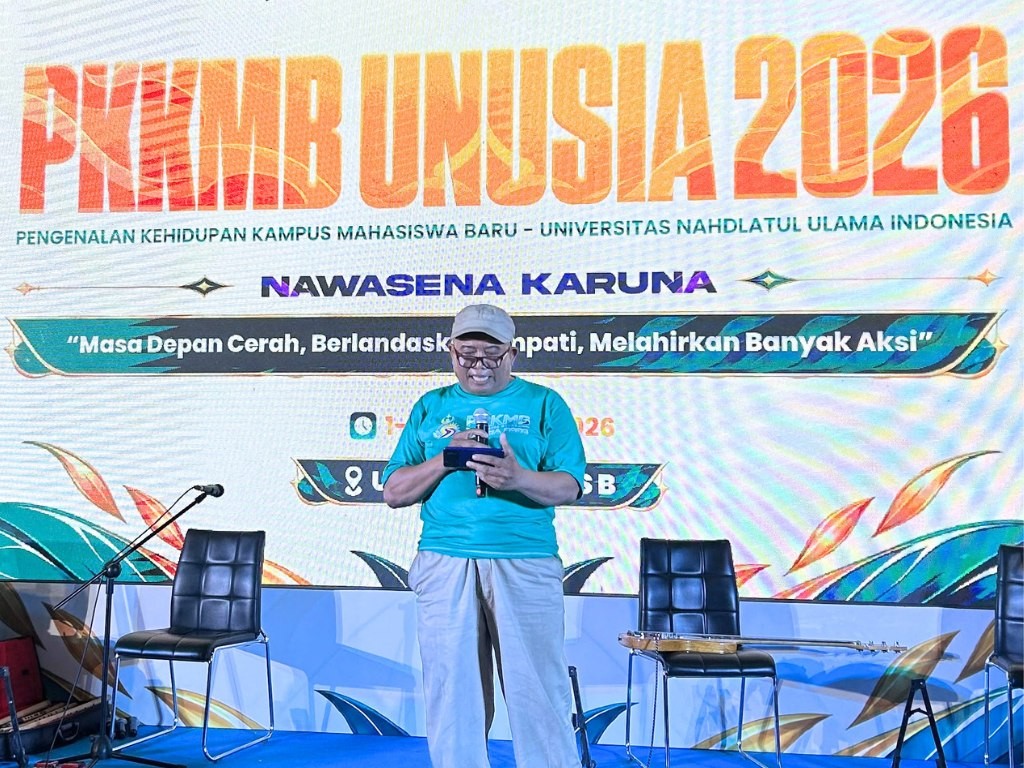
Being a university student should not stop at the mere pursuit of a degree. There is a far more significant journey underlying it: learning to understand the world, interpreting reality, questioning what has long been taken for granted, and discovering ways for knowledge to bring tangible benefits to life.
Higher education exposes individuals to a vast array of knowledge, ideas, theories, and perspectives. Yet, knowledge never exists in a vacuum; it constantly confronts a complex reality—people with diverse experiences, societies with their own traditions and challenges, and an ever-evolving world. Therefore, it is not enough for students to simply memorize information. They need a mindset that enables them to perceive what lies beneath the surface of things.
This is where critical reasoning becomes essential. Students must have the courage to ask questions: Why does something happen? Who benefits, and who might be disadvantaged? What evidence supports a conclusion? From what perspective is an issue being viewed? Such questions do not signify a tendency to doubt everything; rather, they reflect an awareness that reality is not always as simple as it appears.
Ultimately, one’s worldview shapes how one treats the people within that world. When human beings are viewed merely as numbers, statistics, research subjects, or cogs in a system, something vital is lost from knowledge: humanity itself. Knowledge, therefore, must return to the human element. It needs to be grounded in real life rather than remaining confined to the classroom or stacks of reference materials.
This process requires a methodology—a way of approaching reality with honesty and care. Students must learn to observe before drawing conclusions, listen before passing judgment, understand context before making assessments, and consider diverse perspectives before assuming they are absolutely right. Society is not an inanimate object to be treated at will; rather, it is a living space comprising experiences, relationships, traditions, knowledge, conflicts, and change.
For students raised in the *Ahlussunnah wal Jamaah An-Nahdliyah* tradition, interpreting this reality finds its relevance in the values of *tawassuth* (moderation), *tawazun* (balance), *tasamuh* (tolerance), and *i‘tidal* (uprightness/justice). These values are not merely markers of identity but serve as a foundation for cultivating an intellectual mindset. *Tawassuth* teaches balance; *tawazun* encourages the weighing of various interests and perspectives; *tasamuh* fosters a willingness to listen to and understand differences; and *i‘tidal* guides one to stand firmly for justice.
At this juncture, being a student means learning to forge a connection between knowledge and ethics. Knowledge devoid of ethics can devolve into raw power, while power without responsibility can breed oppression. Therefore, intellectual competence must go hand in hand with character and *adab* (proper conduct and etiquette). Ideally, students should remain open to new perspectives without losing their footing, maintain a critical mind without sacrificing courtesy, and be capable of holding differing opinions without belittling others.
These ideas regarding knowledge, reason, and service stem from a reflection shared by Amsar A. Dulmanan—a Sociology lecturer and Vice Dean of the Faculty of Social Sciences at Nahdlatul Ulama Indonesia University (Unusia)—through a poem recited at the conclusion of the 2026 Unusia student orientation (PKKMB). As new students embark on a fresh chapter of their lives, the poem serves as an invitation to view university studies not merely as a journey toward a degree, but as a process of shaping one’s mindset, interpreting reality, and discovering the significance of knowledge within society.
The poem, titled *“Ilmu, Nalar, dan Jalan Pengabdian”* (Knowledge, Reason, and the Path of Service), conveys a profound idea: education must not stop at the mere acquisition of knowledge. Information must be transformed into knowledge, knowledge translated into praxis, and praxis directed toward the common good. Through this process, education is expected to foster a new awareness regarding the nature of the human being, how one lives alongside others, and the purpose to which one’s knowledge is put.
Being a university student is, therefore, a journey of continuous learning—learning what it means to be human. It involves learning to think through knowledge, read reality critically, act with propriety, remain rooted in tradition while staying open to change, and engage meaningfully with the life around us.
For ultimately, the measure of educational success lies not merely in the degrees earned, but in what one does with the knowledge one possesses.
This ensures that knowledge does not lose its human essence; that reason does not lose its ethical grounding; and that the journey of the university student truly finds its path of service.