Unusia FEB Dean Leads International Collaboration to Publish Sharia-Based Ecological Accounting Research in Q1 Journal JURIS

Humas Unusia
Content Writer
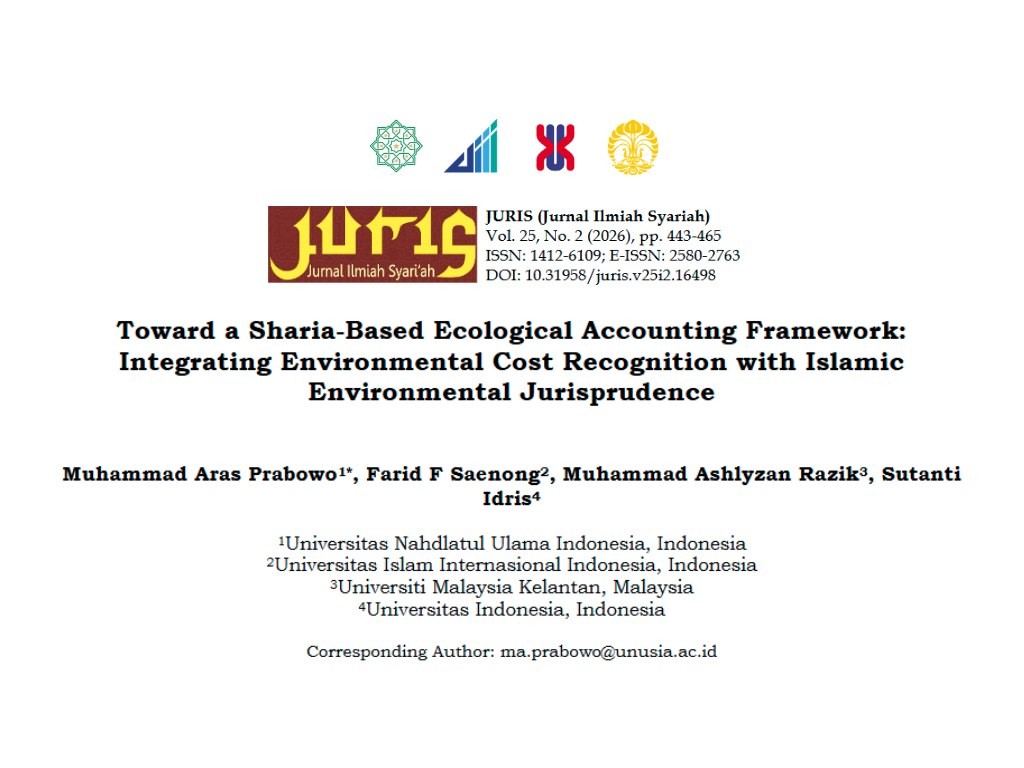
Jakarta — The academic community of Nahdlatul Ulama Indonesia University (Unusia) has once again achieved a notable milestone. The Dean of the Faculty of Economics and Business (FEB) at Unusia, Dr. Muhammad Aras Prabowo, together with a research team comprising members from various national and international universities, successfully published a high-reputation scholarly article in a Scopus Q1-indexed journal.
This internationally acclaimed research was published in *JURIS (Jurnal Ilmiah Syariah)* Vol. 25, No. 2 (2026), titled "Towards a Sharia-Based Ecological Accounting Framework: Integrating Environmental Cost Recognition with Islamic Environmental Jurisprudence (*Fiqh*)."
The study is the result of a strategic collaboration between Dr. Muhammad Aras Prabowo (Unusia), Dr. Farid F. Saenong (Indonesian International Islamic University - UIII), Prof. Muhammad Ashlyzan Razik (Universiti Malaysia Kelantan - UMK), and Sutanti Idris (University of Indonesia - UI).
The research was motivated by the limitations of conventional financial accounting practices, which frequently overlook the costs associated with environmental damage. Historically, companies have tended to treat negative impacts—such as carbon emissions, deforestation, air pollution, and biodiversity loss—merely as externalities rather than as financial liabilities that must be recognized and accounted for.
Furthermore, conventional reporting frameworks based on Corporate Social Responsibility (CSR) and Environmental, Social, and Governance (ESG) criteria are often criticized for falling into the traps of "greenwashing" (image-building) and "decoupling" (where practices remain merely administrative formalities). “Conventional accounting systems suffer from a fundamental weakness: they lack a binding ecological basis for calculating restoration costs. Conversely, we possess an environmental jurisprudence (*fiqh al-bi'ah*) rich in the principles of *maqāṣid al-shari'ah* and the maxim *lā ḍarar wa lā ḍirār* (neither inflicting harm nor reciprocating it); yet, to date, these have not been operationally formulated into accounting and auditing standards,” stated Dr. Muhammad Aras Prabowo.
Employing an empirical socio-legal methodology, a bibliometric mapping of 215 Scopus/Web of Science articles, and in-depth interviews with experts in accounting, Islamic law, and environmental activism, the research team formulated an operational Sharia-based Ecological Accounting Model.
This framework integrates five key components:
1. Ecological Cost Recognition: Mandates the accurate identification and measurement of costs related to mitigation, land rehabilitation provisions, ecosystem restoration, and tangible compensation for affected communities.
2. Sharia-based Ethical Classification: Categorizes a business entity's environmental obligations based on the principles of protecting life and property (*maqāṣid al-shari'ah*), the public interest (*maslahah*), and the prevention of harm (*lā ḍarar wa lā ḍirār*).
3. Governance Integration: Incorporates accountability and ecological risk into the oversight functions of the Board of Commissioners, the Sharia Supervisory Board (DPS), and the Risk Committee, while also engaging local communities. 4. Transparent Reporting & Disclosure: Disclosing in detail estimated environmental restoration liabilities and provision funds within the entity's annual financial statements.
5. Independent Verification & Audit (Assurance and Verification): Mandating independent environmental audits, Sharia-ethical reviews, and field verifications conducted jointly with the community.
These research findings also hold significant implications for regulators and the industry, particularly within the extractive, palm oil plantation, energy, and manufacturing sectors. The research team recommends shifting the reporting of ecological costs from a voluntary basis to a mandatory requirement.
Furthermore, banking institutions and Sharia capital markets are encouraged to tighten their Sharia screening criteria. Sharia investment screening must not focus solely on the absence of *ribā* (usury) or the legal validity of contracts (*halal* status); it must also take into account a company's ecological track record and environmental restoration obligations.
The publication of this Q1-ranked scholarly article serves as tangible proof of FEB Unusia’s commitment to fostering high-reputation research focused on the public good and environmental well-being.
The full article is openly accessible via the official JURIS journal link:
👉 [Towards a Sharia-Based Ecological Accounting Framework (JURIS 2026)] (https://ejournal.uinmybatusangkar.ac.id/ojs/index.php/Juris/en/article/view/16498)