Unusia Advocates for Reformulating PTNU Governance at Strategic Forum

Humas Unusia
Content Writer
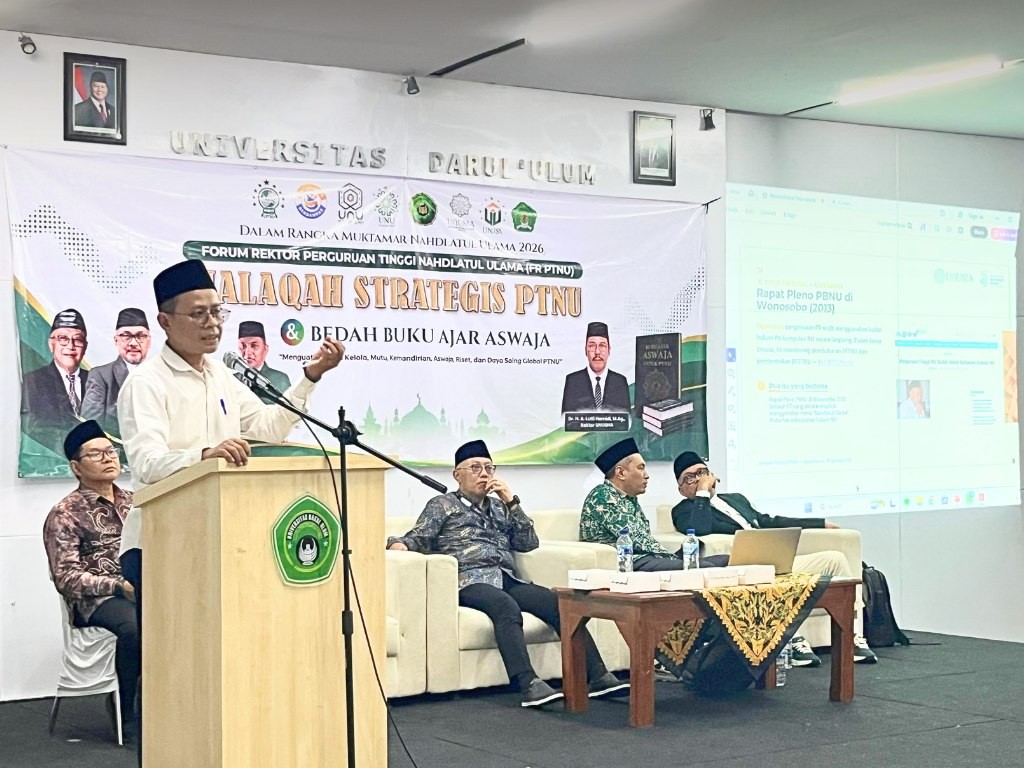
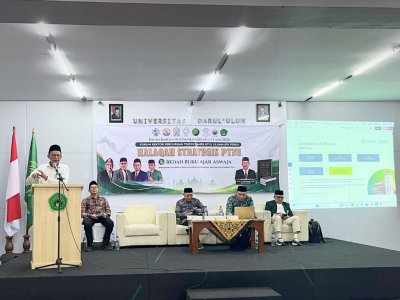
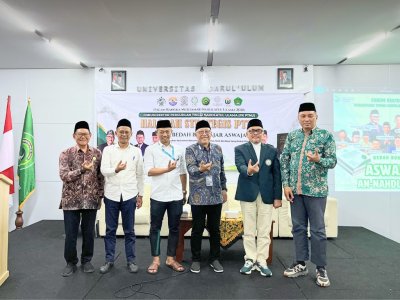
Jombang — Universitas Nahdlatul Ulama Indonesia (Unusia) proposed a reformulation of the governance and legal relationships of Nahdlatul Ulama Higher Education Institutions (PTNU) during the PTNU Strategic Forum held at Universitas Darul Ulum, Jombang, on Saturday (August 29, 2026). The proposal aims to strengthen governance and bureaucratic efficiency while enhancing the quality and reputation of PTNU institutions.
The presentation, titled "Reconstructing the Governance and Legal Relationships of Nahdlatul Ulama Higher Education Institutions (PTNU)," was delivered by Naeni Amanulloh, Unusia’s Vice Rector for Networking, Innovation, and Institutional Relations. In the presentation, Naeni explained that strengthening PTNU governance requires revisiting the recommendations from the 2013 PBNU (Executive Board of Nahdlatul Ulama) Working Meeting Plenary regarding the coordination of higher education institutions bearing the Nahdlatul Ulama name via LPTNU (the Nahdlatul Ulama Higher Education Institute). He argued that LPTNU’s function should focus on strengthening coordination, supervision, and management support for PTNU institutions without altering the ownership status of their assets.
Naeni also emphasized that LPTNU should be positioned as a body established based on objective needs within specific regions or branches, rather than as a structural obligation. Furthermore, Unusia proposed transferring the authority to appoint PTNU Rectors from PBNU to LPTNU. This proposal is grounded in the principle of subsidiarity, whereby authority is delegated to the entity closest to the matter and possessing the relevant competence. According to Naeni, this step is crucial for supporting the stability, consistency, and sustainability of PTNU institutions as academic entities.
The proposal is underpinned by three lines of argumentation: historical, normative, and governance-related. Historically, the *Lajnah* status represented an early form of NU’s higher education administrative body, prior to the standardization of all *Lajnah* units into *Lembaga* (Institutes) during the 33rd *Muktamar* (National Congress) in 2015. From a normative standpoint, however, Unusia considers the *Lajnah* model—characterized by its conditional nature—to be better suited to the needs of the higher education sector, given its unique nature and high level of regulation.
Regarding governance, Unusia emphasizes the importance of ensuring that the establishment and development of NU Higher Education Institutions (PTNU) are grounded in actual needs and readiness—including the availability of academic personnel, student potential, funding, and institutional preparedness. This approach is seen as a way to avoid establishing institutions driven more by structural demands than by substantive readiness.
Furthermore, transferring the authority to issue Rector appointment decrees to the Higher Education *Lajnah* has been proposed as a means to implement the principles of subsidiarity and bureaucratic efficiency. Under this mechanism, decisions concerning the management and academic aspects of PTNUs could be handled by a body possessing specialized competence in higher education, while simultaneously streamlining bureaucratic processes.
Unusia Rector Fariz Alnizar stated that the proposal stems from a study considering various aspects, ranging from regulations to the philosophical and historical foundations of NU’s higher education operations.
“This proposal is based on an in-depth study we conducted. Naturally, beyond analyzing the regulations applicable within Nahdlatul Ulama, the philosophical aspects of conducting higher education and the historical basis for establishing PTNUs also serve as foundations for the proposal.”
According to Fariz, refining the relationships and governance of PTNUs is a crucial part of efforts to sustainably strengthen the quality of NU higher education institutions.
“We view the improvement of PTNU governance and relationships as a critical issue, integral to our commitment to enhancing the quality and future reputation of these institutions.”
The proposed governance changes are not intended to diminish the authority of the PBNU (NU Executive Board) regarding the guidance and supervision of PTNUs. Unusia also affirms that the requirement to utilize the NU Association (*Perkumpulan NU*) as the legal entity operating these higher education institutions remains unchanged. The reformulation aims to establish a division of authority that better aligns with the competencies and management needs of higher education.
Through this proposal, Unusia advocates for the future development of the PTNU network to move beyond a mere focus on fulfilling organizational structures; instead, it should be grounded in the specific needs, readiness, and capacity of each region. This approach is expected to strengthen PTNU governance while simultaneously enhancing the quality and reputation of NU higher education institutions.