Unusia Leads the 'Independent Cluster' (Klaster Mandiri) in the 2026 PTNU Rankings, Strengthening Its Commitment as a 'Community Development University'

Humas Unusia
Content Writer
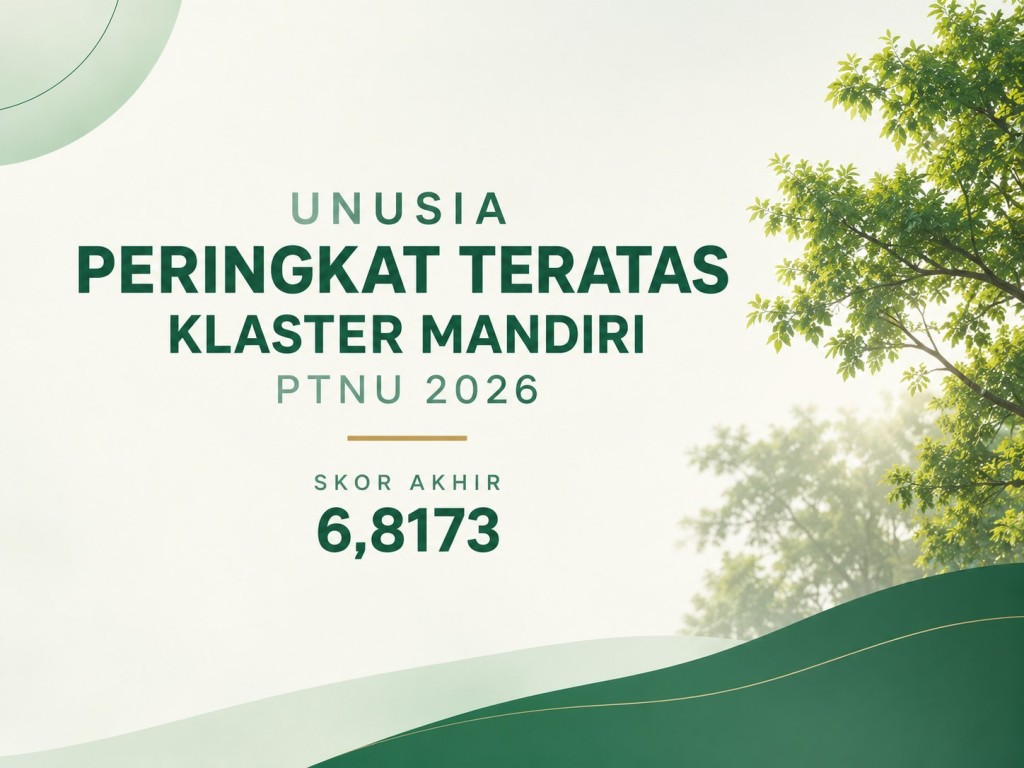
Jakarta — Universitas Nahdlatul Ulama Indonesia (Unusia) has secured the top position within the 'Independent Cluster' (Klaster Mandiri) in the 2026 Excellence Rankings for Nahdlatul Ulama Higher Education Institutions (PTNU). According to data from the Nahdlatul Ulama Higher Education Institute (LPTNU), Unusia achieved a final score of 6.8173 within this cluster, which encompasses institutions ranked between 10th and 25th place.
The 2026 PTNU Excellence Rankings utilize seven assessment variables, with a total weight of 100 percent. These indicators include: the number of active students (20 percent weight), assets and financial sustainability (10 percent), research performance and scientific publications (20 percent), the number of professors and associate professors (15 percent), altmetrics-based academic reputation (15 percent), alumni achievements (10 percent), and the strength of ties to the Nahdlatul Ulama organization and its autonomous bodies (10 percent).
These diverse indicators demonstrate that an institution's excellence is evaluated across multiple dimensions—ranging from academic capacity and institutional sustainability to reputation and integration within the Nahdlatul Ulama ecosystem. For Unusia, this result serves as a catalyst to continue institutional improvements and ensure that its ongoing development yields increasingly broad benefits.
Unusia Rector Fariz Alnizar welcomed the achievement, attributing it to the collective efforts of the entire academic community, alumni, and the university’s partners. He noted that this ranking serves as an encouragement to further develop the institution while expanding its positive impact on society. “We are grateful and proud of Unusia’s achievement in securing the top rank within the ‘Independent’ (Mandiri) cluster. This is the result of the hard work and collaboration of the entire Unusia academic community—from faculty members, administrative staff, and students to the support provided by our alumni and partners,” said Fariz.
For Unusia, this achievement is not merely about a ranking position; it serves as a reminder that the development of a higher education institution must go hand in hand with improvements in quality and social contribution. Consequently, strengthening academics, research, scholarly publications, and institutional governance has become a vital part of the university’s future development agenda.
“We will continue to bolster our academic quality, research, scholarly publications, and institutional governance. For Unusia, excellence is not just about institutional accolades, but also about the extent to which the university’s presence can address needs and deliver a tangible impact on society,” Fariz stated.
Fariz emphasized that Unusia will continue to be guided by three pillars of leadership: Acceleration, Collaboration, and Transformation. These serve as the foundation for enhancing the quality of education, expanding partnership networks, and reinforcing Unusia’s role as a ‘Community Development University’—an institution that places community development at the core of its ‘Tridharma’ (the three pillars of higher education: education, research, and community service).
“We are optimistic that, through the spirit of collective effort (*gotong royong*) shared by the entire Unusia family, this achievement will serve as a stepping stone to advance further and make an even greater contribution to the community, the nation, and humanity,” Fariz added.
This milestone provides a foundation for Unusia to continue its growth by integrating academic quality and community service into the very fabric of its institutional development. In this way, success in rankings is expected to align with the university’s concrete contributions to the community, the nation, and humanity.