Unusia's FIN Dean Ahmad Suaedy Launches Book on Islam, Conflict, and Political Transformation in Southeast Asia

Humas Unusia
Content Writer
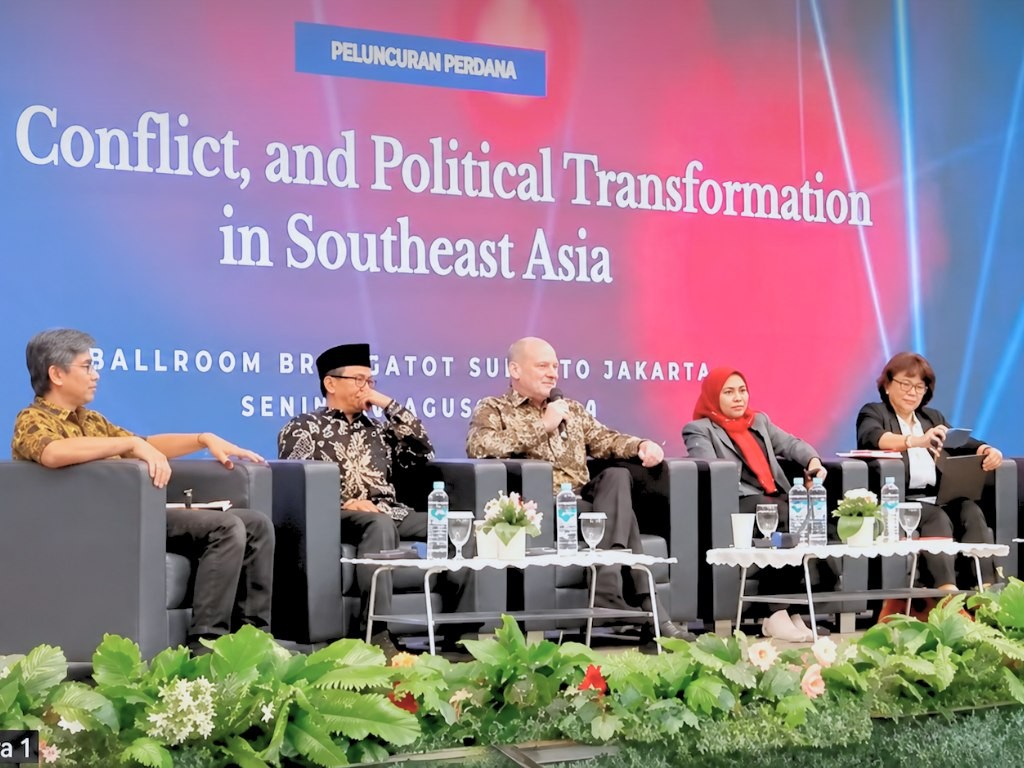
Jakarta – Ahmad Suaedy, Dean of the Faculty of Nusantara Islam (FIN) at the Nahdlatul Ulama University of Indonesia (Unusia), participated in the premiere launch of the book *Islam, Conflict, and Political Transformation in Southeast Asia*, held at the BRIN Ballroom in Gatot Subroto, Jakarta, on Monday (August 10). Edited by Ahmad Suaedy, James B. Hoesterey, Amin Mudzakkir, and Ahmad Nuril Huda, the book examines the dynamics of Islam, conflict, and political transformation across Southeast Asia.
During the launch event, Ahmad Suaedy recounted the lengthy process behind the book's creation, which originated from a collective idea regarding the study of Islam in Southeast Asia. The process spanned approximately three years, encompassing program and proposal development, intensive discussions with fellow editors and BRIN researchers, contributor selection, chapter drafting, and the final editing and publication stages.
"For this book to be published in 2026, the process required at least three years. It started with drafting the program or proposal through quite intensive discussions—both with fellow editors and with colleagues at BRIN and elsewhere," said Ahmad Suaedy.
He explained that the book does not view political transformation merely as institutional change; rather, it examines how such changes impact people's daily lives. This perspective is then integrated with discussions on Islam, conflict, and peace in Southeast Asia.
A central idea of the book is to view Islam as a social force capable of entering the public sphere to foster peace, dialogue, and conflict resolution. Ahmad Suaedy emphasized that the book does not frame Islam solely in terms of theology or creed, but also as a social and spiritual practice within the reality of pluralistic and multicultural societies.
"The phenomenon of Islam entering the public sphere acts as a driving force for peace, dialogue, and conflict resolution. Here, Islam is interpreted not in the sense of creed, but rather as social and spiritual practice," he explained. According to Ahmad Suaedy, this perspective broadens the understanding of religious conflict. Conflict is not defined merely as a clash between religions or between sects within a religion; it also encompasses various dimensions—such as power dynamics, land disputes, military conflicts, and inter-ethnic tensions—provided that religion plays a role in them.
“Here, religious conflict is understood as a multi-dimensional phenomenon—involving power, land disputes, military issues, inter-ethnic tensions, and so forth—wherever religion is involved, regardless of the extent of that involvement,” he said.
He added that this broader understanding also applies to the approach taken toward conflict resolution. Resolving religious conflicts cannot rely solely on theological, spiritual, or traditional approaches; it also requires addressing the surrounding social and political complexities.
Through the book *Islam, Conflict, and Political Transformation in Southeast Asia*, the editors and authors aim to present perspectives on how Islam can contribute to addressing the complexities of conflict while fostering peace in Southeast Asia. The book's launch is expected to serve as a vehicle for disseminating research findings and enriching the discourse on Islam, diversity, conflict, and political transformation in the region.