Unusia Hosts Pre-35th Muktamar Discussion on NU’s Transformation in Its Second Century

Humas Unusia
Content Writer
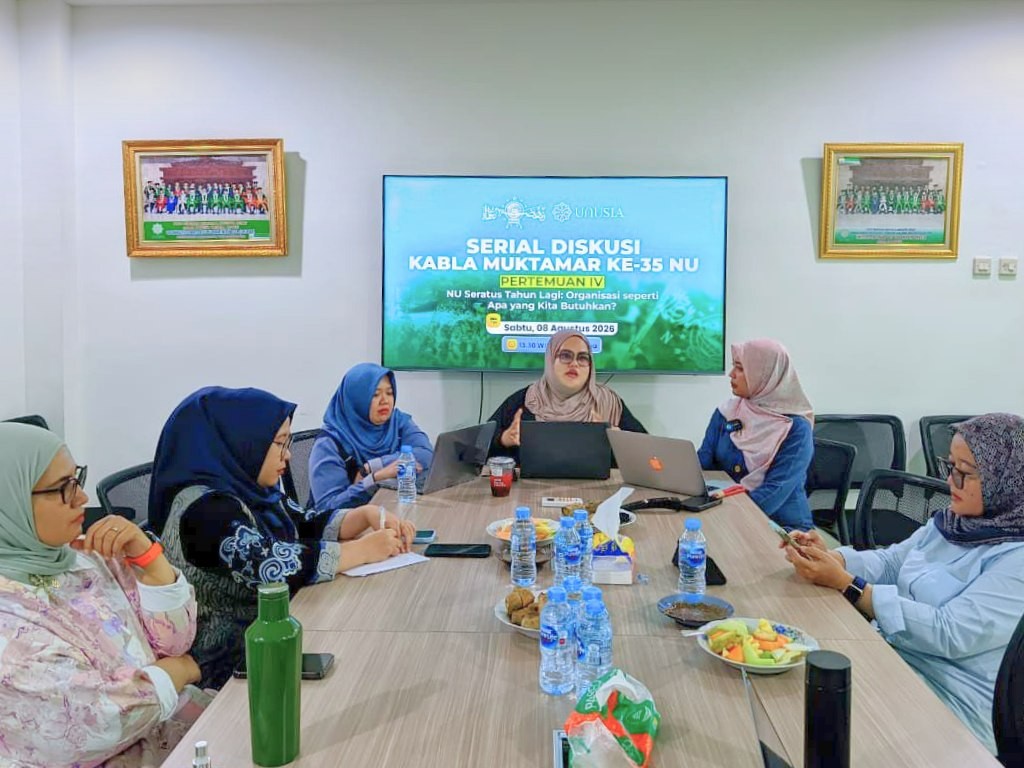
Jakarta – Ahead of the 35th *Muktamar* (National Congress) of Nahdlatul Ulama (NU), the academic community at the Nahdlatul Ulama Indonesia University (Unusia) has once again addressed the organization's future direction through a series of pre-congress discussions. The fourth meeting focused on presenting and refining recommendations formulated during the three previous sessions.
This meeting specifically engaged women and faculty members from Unusia to provide input on the outcomes of earlier discussions. Three major themes were addressed: the transformation of NU’s authority and governance; the fulfillment of social commitments and the promotion of community welfare; and the future of *pesantren* (Islamic boarding schools) and education. These sessions yielded 14 recommendations intended to contribute intellectual insights to the 35th NU *Muktamar*.
One issue receiving significant attention was how NU manages its authority amidst a changing era. The rise of digital technology means that the generation of ideas no longer occurs solely through the organization's formal structures but also through influential figures and digital spaces. Consequently, academics advocated for organizational reform by strengthening meritocracy, digitizing governance, and restructuring the *AHWA* (Council of Religious Scholars) so that it remains active beyond the specific moments of leadership elections.
This transformation also extends to NU’s relationship with the state. It was argued that NU needs to maintain a healthy distance from state interference without forfeiting its strategic role in national life. The proposed stance is not merely that of a pressure group, but rather a force capable of shaping public policy and driving development that prioritizes the community's interests.
Simultaneously, the discussions positioned *pesantren* as a crucial foundation for NU’s future. *Pesantren* are encouraged to preserve their scholarly traditions while adapting to new demands. The hope is for *pesantren* education to produce *ulama* (religious scholars) who also possess competence in STEM (Science, Technology, Engineering, and Mathematics) fields.
This strengthening of *pesantren* was subsequently linked to NU’s need for professional human resources. NU higher education institutions, including Unusia, are viewed as occupying a strategic position as spaces for intellectual dialogue that bridge the Islamic intellectual heritage with modern science. Consequently, *pesantren* (Islamic boarding schools) and higher education institutions serve not only to preserve tradition but also to function as part of a knowledge-production ecosystem capable of addressing the challenges facing NU as it enters its second century.
The recommendations formulated during the fourth meeting are intended to go beyond mere conceptual proposals; they are expected to serve as substantive input for the main forum of the *Muktamar* (National Congress). Unusia academics emphasize the importance of their active participation within the NU framework and stress the need to ensure that the formulated ideas can be implemented to drive future organizational improvements.